
The Best Plays to Run When You Need a Clutch Basket: Game-Winning Strategies for Every Defense
What Makes a Play “Clutch”?
Before diving into specific plays, let’s clarify what makes a play truly “clutch”:
- High percentage shot opportunity – Creates a high-quality look with the highest possible chance of success
- Adaptability – Can be adjusted based on personnel and defensive coverage
- Multiple options – Primary, secondary, and even tertiary options if the defense takes away the first look
- Time management – Appropriate for the time remaining on the clock
- Leverages strengths – Puts your best players in positions where they excel
Now let’s explore the most effective clutch-time plays against different defensive setups. To implement these successfully, you’ll need players with a solid foundation in core basketball fundamentals and a team with high basketball IQ.
Best Clutch Plays Against Man-to-Man Defense
1. The Isolation (ISO)
The isolation play remains a staple in late-game situations for teams with an elite scorer who can create their own shot.
How it works:
- Clear out one side of the court
- Get the ball to your best creator in their preferred spot
- Let them attack one-on-one while teammates space the floor
- Set a high screen if needed to force a defensive switch
When to use it:
This play works best when you have a clear mismatch or an elite scorer who thrives under pressure. Players like Damian Lillard, Kevin Durant, and Kyrie Irving have made careers out of clutch isolation buckets.
Pro tip: The key to a successful isolation isn’t just having a great one-on-one player—it’s proper floor spacing. Other players should position themselves to maximize driving lanes while remaining legitimate passing threats. Teaching players how to move without the basketball is crucial for this spacing.
2. Pick and Roll/Pop
The pick and roll remains basketball’s most versatile play, and in clutch situations, its simplicity and effectiveness make it a go-to option. For a deeper understanding, check out our guide on how to pick and roll like a pro.
How it works:
- Your best ball-handler receives the ball at the top of the key
- A big sets a screen, creating either a driving lane or forcing a defensive switch
- The ball-handler can drive, pull up for a jumper, or pass to the rolling/popping screener
- Weak side actions can add complexity and additional options
When to use it:
This play works in almost any situation but is particularly effective when you have a skilled ball-handler and a versatile big who can either finish at the rim or hit a mid-range jumper.
Pro tip: The timing of the screen is crucial. Setting it too early allows the defense to recover, while setting it too late might not create enough advantage. Strong dribbling skills are essential for the ball-handler in this situation.
3. Elevator Doors
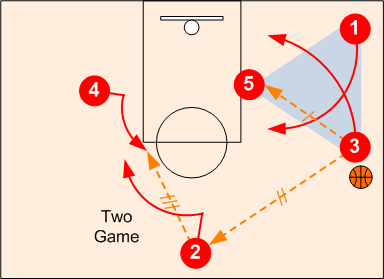
For teams with elite shooters, the elevator doors play creates an open look from beyond the arc.
How it works:
- Two bigs set up side by side near the free throw line
- Your shooter cuts between them toward the top of the key
- As the shooter passes through, the bigs close the “doors” by stepping together
- This prevents the defender from following your shooter
- The shooter receives the ball for an open three-point attempt
When to use it:
When you need a three-pointer and have a reliable shooter plus two solid screen setters.
Pro tip: Timing is everything with this play. The screens must be set legally, and the shooter needs to curl tightly through the “doors.” Working on proper shooting form and catch-and-shoot techniques will maximize the effectiveness of this play.
Best Clutch Plays Against Zone Defense
1. 1-3-1 Zone Buster
Zone defenses can be challenging in clutch situations, but the 1-3-1 zone buster creates high-percentage opportunities. For youth coaches, our guide on how to beat a zone defense provides additional strategies.
How it works:
- Position a player in the high post (the zone’s soft spot)
- Attack from the wings, drawing defenders
- Pass to the high post, collapsing the zone
- The high post player can shoot, drive, or find the open teammate when the defense rotates
When to use it:
This play works best against a 2-3 or 3-2 zone when you have a skilled passer in the high post.
Pro tip: Patient ball movement is essential. The goal isn’t necessarily the first open shot but finding the best shot after forcing the zone to shift multiple times. Developing strong basketball passing skills is critical for breaking down zones.
2. Corner Overload
This play forces zone defenders to make difficult choices by overloading one side of the court.
How it works:
- Position three offensive players on one side of the court
- The point guard initiates with dribble penetration toward the overloaded side
- This forces multiple zone defenders to commit
- A quick swing pass to the weak side creates an open shot opportunity
When to use it:
When facing a zone that struggles with rapid ball movement and has slow rotations.
Pro tip: The weak-side player must be ready to shoot immediately or drive if the defender closes out too aggressively. Having players who are comfortable with different types of shots is valuable in this situation.
Best Clutch Plays for Specific Game Situations
1. Need a Quick Two (Under 10 Seconds)
The Quick Curl play creates a quick, high-percentage two-point opportunity.
How it works:
- Start with a box formation (two players at the elbows, two at the blocks)
- Your best shooter starts at one block and curls around screens at both elbows
- The point guard delivers a pass as the shooter clears the second screen
- The shooter catches in rhythm for a mid-range jumper
When to use it:
When you need a quick two-pointer with under 10 seconds remaining.
Pro tip: The screeners should angle their bodies to force the defender over the top of the screen rather than allowing them to slip under. This play relies on strong footwork and balance from your shooter.
2. Need a Three-Pointer (Under 5 Seconds)
The Flare Screen Triple creates an open three-point opportunity in minimal time.
How it works:
- Inbound the ball to your point guard
- Your best shooter sets a screen for another player, then immediately receives a flare screen
- This creates confusion and often forces defensive miscommunication
- The shooter pops to the wing or corner for an open three-point attempt
When to use it:
When you need a three-pointer with minimal time remaining.
Pro tip: The success of this play relies on selling the initial screen. If the shooter doesn’t commit to setting a good screen first, the defense won’t bite on the action. A quick release is crucial here—check out our guide on mastering quick release shooting.
3. Inbounds Play (Under 2 Seconds)
The Stack Release creates a quick shot opportunity with minimal time.
How it works:
- Four players line up in a stack near the basket
- As the inbounder prepares to pass, players break in different directions
- The primary option cuts to the ball side corner
- Secondary options break to the opposite corner and toward the basket
When to use it:
When inbounding with under 2 seconds remaining.
Pro tip: Practice this play with different release patterns so the defense can’t easily predict where players will cut. For more play options, explore our keys to playing offense fast.
Common Mistakes in Clutch Situations
Even the best teams sometimes make these crucial errors in late-game situations:
- Over-complicating the play – Simple, well-executed plays often work better than complex ones in high-pressure moments
- Failing to have a contingency plan – What happens if the primary option is denied?
- Poor time management – Not leaving enough time for a second shot attempt if needed
- Predictability – Always going to the same player or running the same action
- Lack of practice – Special situations must be practiced regularly to execute under pressure
One of the biggest issues in clutch situations is turnovers. Make sure your team understands how to protect the ball in high-pressure moments.
How to Practice Clutch Situations
To improve your team’s performance in clutch situations:
- Simulate game conditions – Practice with actual game timing, score situations, and even crowd noise
- Increase pressure gradually – Start with basic execution, then add defensive pressure and consequences for failure
- Review and analyze – Study film of both successful and unsuccessful clutch plays
- Build confidence – Give different players opportunities to make the big shot in practice
- Condition for clutch moments – Players should be physically prepared for high-intensity moments even when fatigued
Implementing effective basketball drills and creating winning basketball practices will help your team prepare for these crucial moments.
Which Defenses Are Most Effective in Clutch Situations?
Understanding defensive strategies helps offensive players counter them effectively:
- Switching everything – Forces offenses to hunt mismatches but can lead to defensive confusion
- Trap the ball-handler – Forces the ball out of the star player’s hands but creates 4-on-3 opportunities elsewhere
- Zone defense – Disrupts set plays but can leave gaps if offenses are patient
- Full-court pressure – Reduces the time available for the offense but risks giving up a fast break opportunity
For coaches looking to implement strong defensive strategies, check out our collection of basketball defense drills and tips on how to play defense.
Frequently Asked Questions
Should you always go to your best player in clutch situations?
While your star player should typically have a major role in clutch plays, becoming too predictable makes you easier to defend. The best clutch plays put your top scorer in advantageous positions while maintaining options for others if the defense overcommits.
Is it better to call timeout or play through in clutch moments?
Both approaches have merit. Calling timeout allows you to set up a specific play but gives the defense time to prepare as well. Playing through often catches the defense before they can set up but relies more on player decision-making. The best coaches prepare for both scenarios.
How important is shot selection in clutch moments?
Extremely important. Research shows that teams often settle for lower percentage shots in clutch situations due to pressure. The best clutch plays create high-percentage opportunities—layups, dunks, or open three-pointers—rather than contested mid-range jumpers.
How do you prepare mentally for clutch situations?
Mental preparation is as important as physical execution. The best clutch performers:
- Visualize success regularly
- Practice pressure situations extensively
- Develop consistent pre-shot routines
- Focus on process rather than outcome
- Embrace rather than fear big moments
For more on the mental aspect of basketball, read about life lessons in basketball that help players in clutch moments.
Conclusion
Executing in clutch situations separates good teams from championship contenders. The best plays balance simplicity with effectiveness, putting players in positions to succeed while providing multiple options. Remember that clutch performance isn’t just about drawing up the perfect play—it’s about preparation, confidence, and execution under pressure.
Make sure to check out basketballfundamentals.com for more information! Our free video tutorials break down these clutch plays with detailed examples from professional and college games. Visit our site on basic basketball fundamentals to elevate your late-game execution and become the player or coach your team trusts when the game is on the line.