
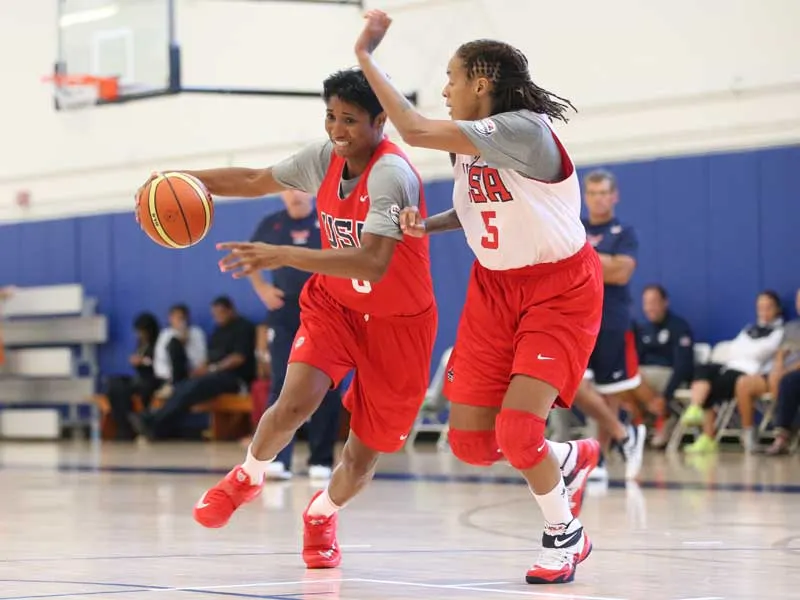
The Evolution of the Eurostep: From Controversial Move to Basketball Staple
Origins of the Eurostep: European Roots in American Soil
The Eurostep’s name reveals its geographical origins – a move developed and perfected in European basketball leagues before making its way to American courts. Unlike the more straightforward, North-South driving style traditionally taught in American basketball, European players developed a more fluid, lateral approach to navigating defenders.
While European players had been using similar movements for decades, the modern Eurostep as we know it today gained prominence in the 1980s and early 1990s. Players like Šarūnas Marčiulionis, a Lithuanian guard who joined the Golden State Warriors in 1989, were among the first to bring this distinctive European footwork to the NBA.
Marčiulionis, trained in Soviet basketball systems that emphasized footwork and movement without the ball, used the step to create angles when driving to the basket. Rather than powering straight through defenders as was common in American basketball at the time, he would take his two allotted steps in different directions to navigate around obstacles.

Why Was the Eurostep Initially Called a Travel?
When players like Marčiulionis first introduced the Eurostep to NBA courts, referees, coaches, and fans alike were quick to call it a travel violation. There were several key reasons for this controversy:
Traditional Interpretation of the Traveling Rule
For decades, American basketball had interpreted the traveling rule in a relatively straightforward manner: a player could take two steps after gathering the ball, but those steps were expected to be in a continuous, forward direction. The Eurostep’s side-to-side nature appeared to violate this traditional understanding.
Basketball official Tom Washington explained in a 2010 interview: “We were trained to watch for a clear gather followed by two steps in sequence. When players started taking that second step in a completely different direction with such emphasis, it looked like an extra step to many officials.”
Visual Deception
The Eurostep is designed to be deceptive – that’s its purpose. The dramatic change in direction creates the illusion of more steps being taken than actually are. As former NBA referee Joey Crawford noted, “The move happens so quickly and with such a dramatic shift that your eyes can trick you into thinking you’ve seen three steps when there were only two.”
Learning to master this deceptive movement requires excellent footwork and staying on the balls of your feet, which gives players the agility needed to change direction quickly.
Cultural Basketball Differences
American basketball had developed with certain offensive norms that differed from European play. The Eurostep challenged these established patterns, making it appear foreign and potentially illegal to those who had spent decades watching and officiating a more linear style of basketball.
Understanding these cultural differences is part of developing a higher basketball IQ and learning to read the game like a pro.
Manu Ginóbili: The Eurostep Ambassador
While Marčiulionis introduced the move, it was Argentine guard Manu Ginóbili who truly popularized the Eurostep in the NBA during the early 2000s. Ginóbili had perfected the move while playing professionally in Italy before joining the San Antonio Spurs in 2002.
Ginóbili’s Eurostep was particularly effective because of his ambidexterity and creativity. He could gather the ball, take a step in one direction to make defenders commit, then take his second step in the opposite direction before finishing with either hand. This combination of deception and finishing ability made the move nearly unstoppable.
Spurs coach Gregg Popovich admitted in a 2015 interview: “When Manu first started doing that move, I thought it was a travel every time. It took me a while to understand that it was actually legal. Once I did, I recognized what a weapon it was.”
NBA Rule Clarification: Legitimizing the Eurostep
As more players began incorporating the Eurostep into their games, the NBA was forced to examine and clarify its traveling rules. The league determined that the move was indeed legal as long as players maintained their pivot foot appropriately and took no more than two steps after gathering the ball.
The NBA’s official rule book states that a player who receives the ball while moving is allowed two steps to come to a stop, pass, or shoot. The direction of those steps is not specified, which is what makes the Eurostep legal.
In 2009, the NBA released an official points of emphasis video for officials that specifically addressed the Eurostep, confirming its legality and helping referees properly identify legal versus illegal execution of the move.
Understanding these rules is essential for players at all levels – it’s one of the basketball rules every young player must master to avoid costly violations during games.
The Modern Eurostep Masters
Today, the Eurostep has become a fundamental offensive skill taught at all levels of basketball. Players like James Harden, Giannis Antetokounmpo, and Dwyane Wade have built significant parts of their offensive games around variations of the Eurostep.
Harden’s version often involves a gather step followed by his two legal steps, stretching the rule to its limit while remaining legal. Giannis uses his extraordinary length to cover massive distances with his Eurostep, sometimes appearing to start his move from the three-point line.
Basketball skills trainer Drew Hanlen explains: “The modern Eurostep is about creating maximum displacement with your legal steps. The best practitioners can make a defender commit in one direction with their first step, then completely clear the defender with their second.”
To execute a Eurostep like these pros, players need to improve their first step and develop the explosiveness needed to blow by defenders.
The Impact on Basketball Strategy
The widespread adoption of the Eurostep has fundamentally changed basketball strategy on both ends of the court:
Offensive Evolution
The move has given offensive players a powerful weapon for finishing in traffic. Rather than trying to power through contact, players can use the Eurostep to avoid defenders altogether, leading to higher-percentage finishing opportunities.
Basketball analyst Zach Lowe noted: “The Eurostep has helped create a generation of players who are more comfortable attacking the rim than ever before. It’s allowed smaller players to finish among the trees.”
The Eurostep is also an excellent way to create space and shoot over taller defenders, giving players of all sizes an opportunity to score in traffic.
Defensive Adjustments
Defenders have had to adjust their techniques when guarding drives. The traditional approach of sliding directly in front of a driver is less effective against a good Eurostep. Instead, defenders must maintain more discipline, stay balanced, and anticipate the second step.
Former NBA defender Shane Battier explained: “When the Eurostep became popular, I had to completely rethink how I defended drives. You can’t commit fully to the first step anymore. You have to stay balanced and almost anticipate the change of direction.”
Defenders looking to counter the Eurostep should focus on mastering advanced defensive techniques and weight distribution during defensive slides.
The Eurostep’s Global Legacy
The Eurostep represents something more significant than just a basketball move – it symbolizes the increasing globalization of the sport. What was once considered foreign and illegal has become a standard part of basketball at all levels.
Youth coaches now teach the Eurostep as a fundamental finishing move, right alongside the traditional layup. The evolution of this technique demonstrates how basketball continues to evolve through cultural exchange and innovation.
The Eurostep has become an essential part of building strong foundations in basketball fundamentals for players who want to excel at finishing around the rim.
FAQs About the Eurostep
Is the Eurostep still considered controversial?
No, the Eurostep is now widely accepted as a legal basketball move when executed properly. Officials at all levels are trained to recognize proper Eurostep execution.
Who is considered the best Eurostep user in basketball history?
While Manu Ginóbili popularized the move in the NBA, players like James Harden and Giannis Antetokounmpo have perhaps perfected it for their individual games. Dwyane Wade also used the move with exceptional effectiveness throughout his career.
Can the Eurostep still be called as a travel?
Yes, if executed improperly. Players must maintain their proper gather and take no more than two steps afterward. Adding a third step or lifting the pivot foot prematurely would result in a traveling violation.
Is the Eurostep taught differently in Europe versus America today?
While there were once significant differences, global basketball training has largely converged. The fundamental principles of the Eurostep are now taught similarly worldwide, though individual coaches may emphasize different aspects of the move.
How has the Eurostep influenced other basketball moves?
The acceptance of the Eurostep has led to more creative footwork in general, including variations like the “spin Eurostep” and the “hop-step Eurostep.” The move has encouraged players to explore the full possibilities within the two-step rule. Learning these advanced moves can help you become unstoppable with your dribbling.
Mastering the Eurostep requires not just technical skill but also mental toughness to use it effectively in game situations, especially when scoring under pressure with defenders nearby.
Make sure to check out basketballfundamentals.com for more information on basketball techniques and history! Want to perfect your own Eurostep? Check out our free video tutorial and explore our site for more essential basketball fundamentals that will elevate your game to the next level.