
The Secret Geometry of Basketball: Why Angles Matter More Than Speed in Scoring and Defense
Ever watched a seemingly slower player consistently outmaneuver faster defenders? Or wondered how certain players always find the perfect passing lane? The answer lies not in athleticism alone, but in basketball’s hidden superpower: angles. Understanding and mastering angles can transform an average player into an efficient scoring machine and lockdown defender.
What Are Basketball Angles?
In basketball, angles refer to the geometric relationships between players, the ball, the basket, and the court boundaries. These invisible lines dictate everything from shooting percentages to defensive positioning. While raw speed and athleticism capture attention, angle awareness operates as the secret weapon separating good players from great ones.
If you’re looking to truly understand the game, you need to first understand the basketball court’s full layout, as this spatial awareness forms the foundation for all angle-based strategies.
Basketball angles include:
- Shooting angles – The trajectory line between your release point and the basket
- Entry passing angles – The clear path between passer and receiver
- Defensive angles – Positioning that cuts off preferred offensive routes
- Rebounding angles – Anticipation of where missed shots will likely travel
- Screen angles – The direction and positioning that creates maximum separation

Why Angles Matter More Than Speed in Scoring
Higher Percentage Shots Through Better Angles
Creating advantageous angles leads directly to easier scoring opportunities. Even the quickest player will struggle against a defender who understands angle positioning.
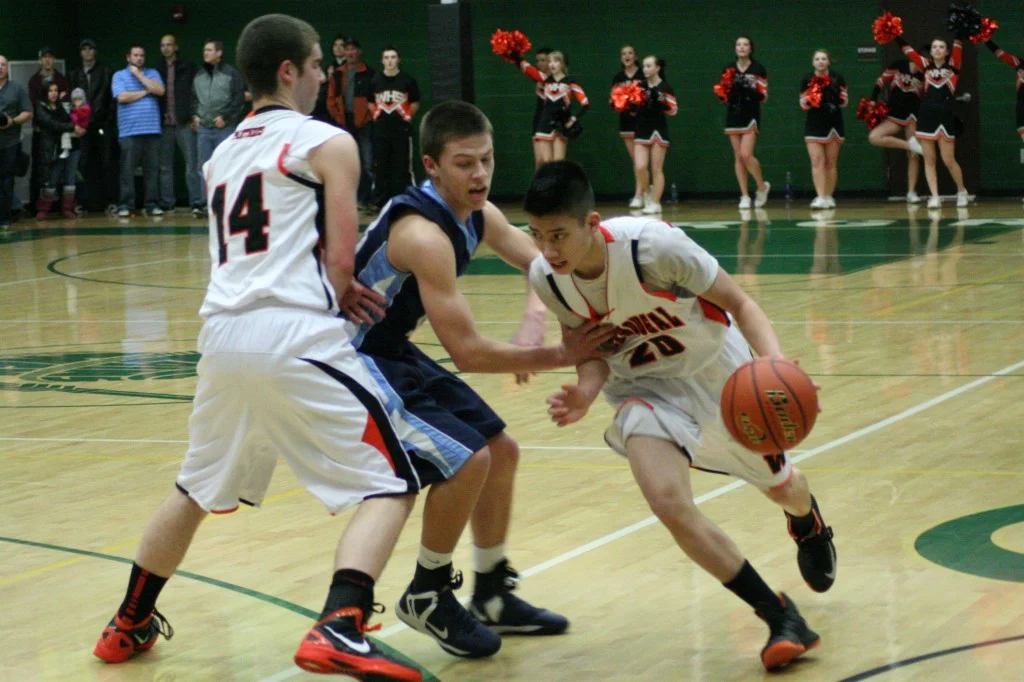
Consider this: A player driving straight at a defender must overcome their full defensive presence. However, by attacking at a 45-degree angle, they force the defender to rotate, creating momentary advantages in timing and positioning. This principle explains why elite scorers like Chris Paul maintained their effectiveness despite not having elite speed.
Research from basketball analytics firms reveals that shots taken from optimal angles (after manipulating defenders) have up to 12% higher conversion rates than equally contested shots where the shooter didn’t create an angle advantage.
To leverage these advantages, players should explore different types of basketball shots and master every angle on the court.
Creating Space Without Speed
The misconception that creating separation requires blazing speed causes many players to rely too heavily on athleticism rather than technique. Watch how master scorers use subtle angle changes to create space:
- Step-back jumpers – Creating shooting angles through lateral space rather than speed
- Fadeaways – Using backward angles to generate separation
- Up-and-under moves – Changing angles to maneuver around defenders
These techniques demonstrate that manipulating angles allows players to create space without elite quickness. Learning how to create space and shoot over taller defenders is a perfect application of angle awareness.
Defensive Angles: The Foundation of Lockdown Defense
Cutting Off Driving Lanes
Elite defenders understand that positioning is about angles, not just quickness. By taking proper defensive angles, you can:
- Force offensive players into help defense
- Make drivers pick up their dribble
- Channel offensive movement to less dangerous areas
Former NBA defensive specialist Shane Battier famously studied shot charts and positioned himself at precise angles to force opponents into their lowest-percentage shots. His approach was mathematical rather than purely athletic.
If you’re looking to develop these defensive skills, check out these 20 basketball defense drills for motivated beginners and learn how to master the fundamentals of basketball defense.
Close-Out Techniques and Recovery Angles
When defending shooters, the angle of your close-out determines your effectiveness more than pure speed. A straight-line close-out often leads to easy drives past the defender. Instead, defensive specialists approach at angles that:
- Contest the shot effectively
- Prevent direct drives to the basket
- Channel offensive players toward help defenders
Understanding the proper angles for a smooth transition from offense to defense can give your team a significant advantage.
How to See Angles in Basketball
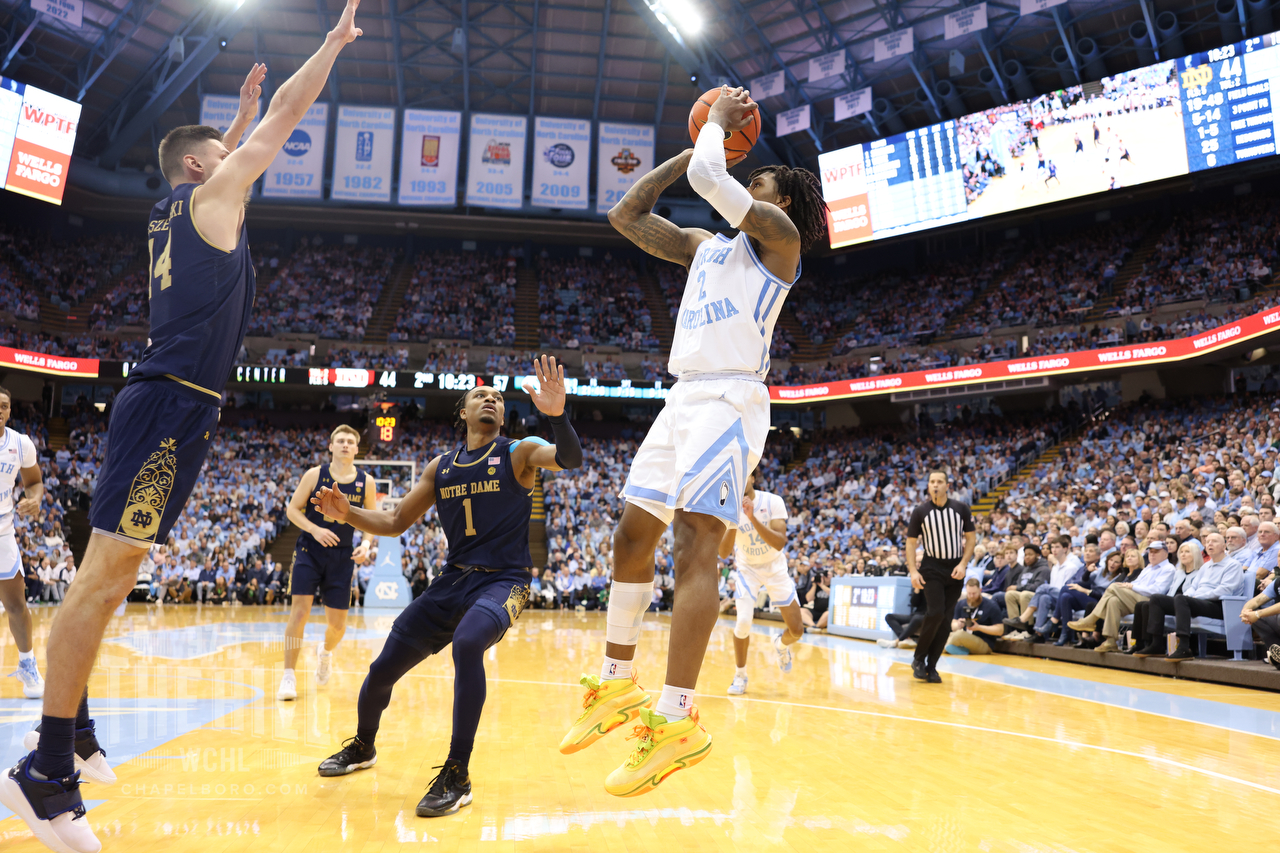
Developing “angle vision” requires practice and conscious effort. Here are proven ways to improve your angle awareness:
Film Study Techniques
One of the most effective methods for understanding angles is studying game film with a specific focus:
- Watch games with the sound off and focus only on off-ball movement
- Pause footage when shots are taken and analyze the positioning of all defenders
- Study elite players known for basketball IQ rather than athleticism
- Track how angles change throughout the shot clock
Former NBA coach Jeff Van Gundy recommends watching games in slow motion to better observe how elite players create and exploit angles. To elevate your game even further, consider mastering basketball film analysis to fix mistakes.
Court Vision Drills
These practical exercises will help develop your ability to see and use angles effectively:
- Triangle passing drills – Practice passing to moving targets while maintaining awareness of defensive positioning
- Cone dribbling patterns – Set up cones in various formations to practice changing directions at specific angles
- Mirror defensive slides – Work with a partner to mirror their movements, focusing on angle rather than speed
- Closeout simulations – Practice approaching shooters at appropriate angles rather than straight lines
Improving your basketball IQ and learning to read the game like a pro will significantly enhance your understanding of angles.
Practicing Angle Awareness
Offensive Angle Drills
- Angled Finishing – Place cones at 45-degree angles from the basket and practice approaching from these positions rather than straight-on drives.
- Window Passing – Set up defenders (or stand-ins) and practice finding passing angles through small windows. Start stationary, then progress to movement.
- Shot Creation – Work on creating separation through angle changes rather than speed. Practice step-backs, sidesteps, and other moves that manipulate angles without relying on pure quickness.
Basketball trainer Drew Hanlen, who works with numerous NBA players, emphasizes that “creating six inches of separation through angle manipulation is often more effective than trying to outrun defenders.”
To enhance these skills, explore these essential basketball drills for every skill level.
Defensive Angle Drills
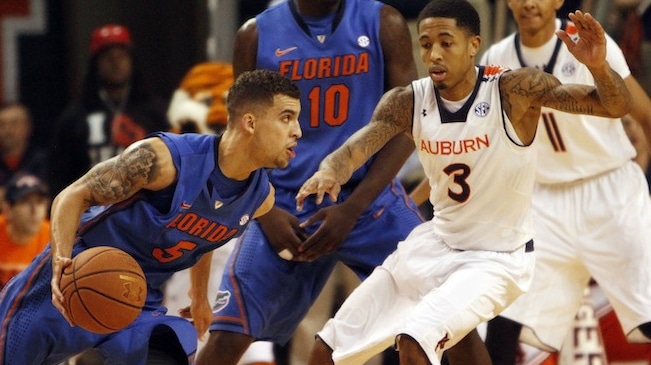
- Channeling Drill – Practice guiding offensive players to sidelines or baseline without reaching, focusing on positioning at proper angles.
- Recovery Angles – Have a partner make a pass, then practice closing out at angles that prevent both the shot and the drive.
- Help and Recover – Work on moving into help position at angles that allow quick recovery to your primary defensive assignment.
Former NBA defensive specialist Tony Allen recommends practicing defensive slides at various angles rather than just laterally. “Defense isn’t about being faster,” Allen explains. “It’s about getting to spots first through better angles.”
To further develop these skills, check out advanced defense drills to dominate the court.
Common Angle Mistakes and How to Fix Them
Offensive Angle Errors
- Driving directly at defenders – Instead, attack the defender’s hip or shoulder
- Screening at ineffective angles – Work on setting screens that create maximum separation
- Cutting in predictable patterns – Learn to change direction at unexpected angles
For advanced offensive techniques that leverage angles effectively, explore how to pick and roll like a pro and mastering how to read defenses.
Defensive Angle Mistakes
- Standing directly in front of drivers – Position to influence direction instead
- Closing out in straight lines – Approach at angles that prevent easy drives
- Helping from inefficient angles – Move to positions that allow both help and recovery
To improve your defensive stance and positioning, learn about mastering the low defensive stance and proper weight distribution and defensive slides.
Real-World Applications
The concept of angles translates across all levels of basketball. Youth coaches should emphasize angle concepts early, focusing on:
- Understanding basic court geometry
- Recognizing advantageous passing lanes
- Learning proper defensive positioning
College programs increasingly use technology like motion tracking to analyze and improve players’ angle awareness. NBA teams employ full-time analysts specifically to identify optimal angles for both offensive and defensive schemes.
For coaches looking to implement these concepts, check out these 20 basketball coaching tips to improve your team and learn how to coach youth basketball effectively.
Conclusion
While highlight reels celebrate speed and vertical leaps, basketball’s true sophistication lies in its geometry. By mastering angles, players at any level can dramatically improve their effectiveness without needing elite athleticism. Whether you’re a coach, player, or basketball enthusiast, developing “angle vision” provides a competitive advantage that transcends physical limitations.
Remember: basketball isn’t just a game of inches—it’s a game of angles.
FAQ: Basketball Angles
Q: How can shorter players use angles to their advantage?
A: Shorter players can leverage angles to create separation, find passing lanes, and defend effectively against taller opponents. Understanding angles helps neutralize height advantages.
Q: Are certain angles more effective against zone defenses?
A: Yes! Against zones, 45-degree attacking angles often create better opportunities than direct approaches. These angles force multiple defenders to make decisions. For more on defeating zone defenses, check out how to beat a zone defense.
Q: How do angles relate to the pick-and-roll?
A: The pick-and-roll’s effectiveness depends largely on the angle of the screen, the angle of the defender’s approach, and the angle of the roll to the basket.
Q: Can angle awareness be developed, or is it natural instinct?
A: While some players have natural spatial awareness, angle recognition can definitely be developed through deliberate practice, film study, and specific drills. Consider these 10 ways to improve your basketball game which include angle awareness development.
Q: How do rebounding angles differ from defensive angles?
A: Rebounding angles involve predicting ball trajectory from the shot’s release angle, while defensive angles focus on positioning relative to offensive threats. To master rebounding, explore techniques to become a beast on the boards.
Make sure to check out basketballfundamentals.com for more information! Our free video tutorial series on “Mastering Basketball Angles” provides visual demonstrations of these concepts. Visit our site for more essential basketball fundamentals that will elevate your game!